From: "hal.bookbinder@ucla.edu
To: leadership@iajgs.org
Cc:
Bcc:
Date: Mon, 26 Nov 2018 16:00:22 +0000
Subject: [IAJGS Leadership] December Practicing Safe Computing article - "Practicing Safe ‘Tzedakah’ (Charity)"
IAJGS Leaders,
This month’s Practicing Safe Computing article is "Practicing Safe ‘Tzedakah’ (Charity)". It has been published in the December issue of "Venturing into Our Past", the Newsletter of the Jewish Genealogical Society of the Conejo Valley and Ventura County (JGSCV). Current and prior newsletters are freely available at the Society's website, http://www.jgscv.org.
As the year comes to a close, charities increase their solicitations, on-line, by mail and in the media. Some phony "charities" have names that sound similar to legitimate ones. Some that are legitimate spend an inordinate amount on overhead with little going to the supposed cause. The commercials and other advertising may not help clarify what the charity does with your donation. This article discusses the steps you can take to best assure that your Tsedakah goes to your intended recipients, sharing on-line resources that you can readily access.
All articles published to date are available in a single PDF which includes an index. This resource is freely accessible using the following link:
http://tinyurl.com/ComputingAr
We will continue to update this resource with monthly articles. Consider placing a link to it on your society's web site or otherwise sharing it with your members as an ongoing free resource, reminding them when new articles are available.
If you have any questions or suggestions for future articles, please contact me.
Shalom, Hal
Hal Bookbinder
hal.bookbinder@ucla.edu
Los Angeles, CA

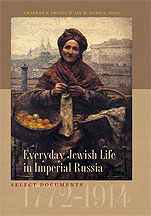 ook makes accessible—for the first time in English—declassified archival documents from the former Soviet Union, rabbinic sources, as well as previously untranslated memoirs, illuminating everyday Jewish life as the site of interaction and negotiation among neighbors, society, and the Russian state, from the beginning of the nineteenth century to World War I. Focusing on religion, family, health, sexuality, work, and politics, these documents provide an intimate portrait of the rich diversity of Jewish life. By personalizing collective experience through individual life stories—reflecting not only the typical but also the extraordinary—these sources reveal the tensions and ruptures in a vanished society. An introductory survey of Russian Jewish history from the Polish partitions (1772–1795) to World War I, along with prefatory remarks, textual annotations, and a bibliography of suggested readings, combine to provide a new perspective on the history of the Jews of Russia.


